

 Back to News & Insights
CA Systematic Approach to BESS Fire Safety
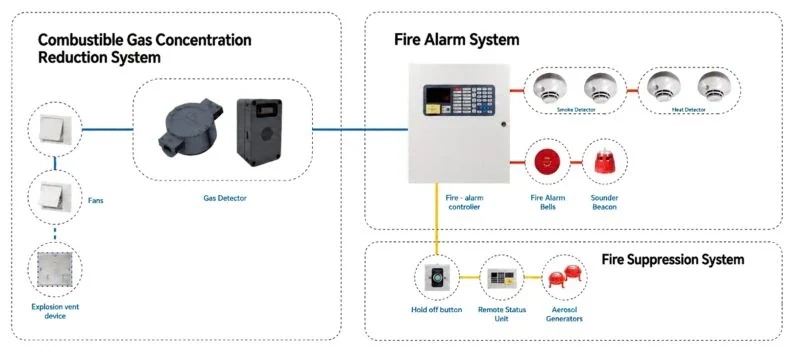
We receive a wide range of inquiries from around the world regarding BESS container safety equipment,including gas detectors, control panels, aerosol systems, and more.
But BESS fire safety is not simply about installing individual devices.
A complete safety system requires different protection layers to work together—from identifying abnormal battery conditions as early as possible, to controlling the response of the system, and finally to suppressing a fire if escalation occurs.
1. Early Detection
Early detection is the first layer of protection.
Gas detectors can identify abnormal gas generation associated with developing battery failure before
conventional smoke or temperature signals become available.
H₂ and CO detection can therefore provide additional time for the system to respond.
2. System Control and Linkage.
Detection alone is not enough.
Once an abnormal condition is identified, the signal needs to be communicated to the wider safety system.
Depending on the project design, this may include linkage with:
- BMS / EMS
- ventilation
- alarms
- shutdown logic
- fire alarm control systems
- suppression systems
The objective is to turn an early signal into an effective response.
3. Fire Suppression
If an event continues to escalate, the suppression system becomes another layer of protection.
The appropriate suppression strategy depends on the battery system, enclosure design, project requirements, and applicable standards.